What is the Helix Growth Score? The 100-300 ladder
The Helix Growth Score is the number at the top of a Helix diagnostic report. This post covers that one number: where it comes from, how to read it, and what it does not mean. For a tour of the rest of the report, see how to read your Helix diagnostic report.
First, where it fits. Most families start Helix from the MAP® score they already have, and practice begins from that score. Those children do not have a Growth Score until they take the diagnostic, which is included and optional. The Growth Score comes only from the diagnostic.
What the Growth Score is
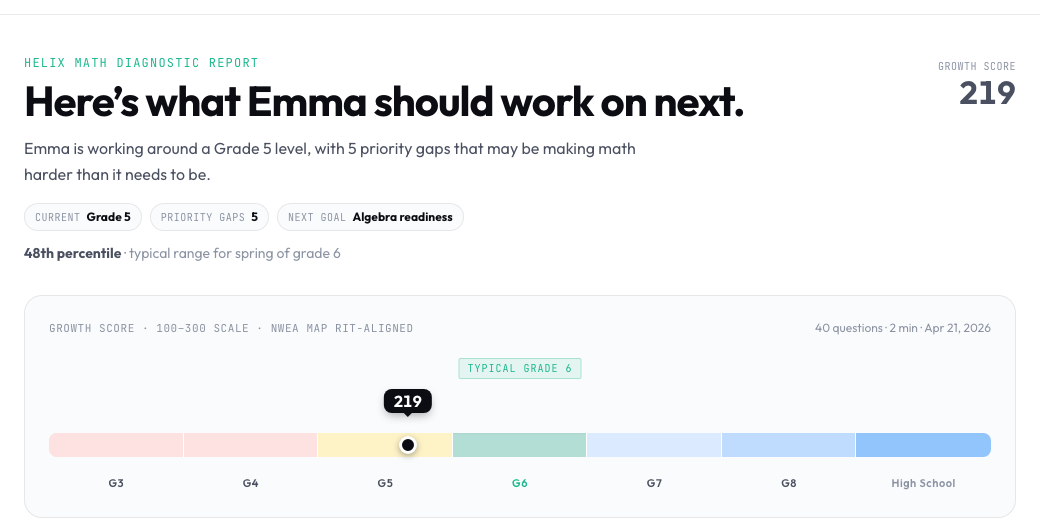
The Growth Score is Helix's estimate, on its own 100 to 300 scale, of where your child is working in math right now. As your child answers diagnostic questions, the estimate moves up or down; the diagnostic ends when it has enough answers to say something useful. The final estimate is the Growth Score.
It is not a percentile and not a percent correct. It does not say your child is "good" or "bad" at math. It is a position on a ruler, shown with a likely range because one sitting can only narrow it down so far.
What it is not: a RIT score
The 100 to 300 range will look familiar if you have seen a MAP report, but the Growth Score is not a RIT® score:
- It is not on NWEA's scale, and it has not been linked to it by any study.
- It does not predict what your child will score on MAP.
- A 215 Growth Score and a 215 RIT are not the same thing, so do not compare them point for point.
Helix's question difficulties are set by our curriculum team and have not yet been estimated from large amounts of student response data. That is part of why the report shows a range rather than a precise number, and why we do not put a MAP-style percentile on it.
If you have a MAP score, use it for what it measures: your child's standing against national, same-grade peers. Use the Helix report for what MAP does not show: which specific skills are secure and which still need practice.
How to read it
Read three things together:
- The standing badge. Below typical, Just below typical, Typical, Just above typical, or Above typical, always compared with your child's own grade. This is the plainest summary on the page.
- The likely range. If the range is wide, the estimate is rough. A plus sign (for example 240+) means your child answered near the top of what the diagnostic measures, so the true level could be higher.
- The ladder. The score is marked on grade bands from G3 through G8, then Above grade 8. Your child's own grade is labelled. The ladder shows the standing badge as a picture. It is not a claim that your child "is at" another grade.
What it does not tell you
The Growth Score is one number. Two children with the same score can need very different practice: one solid on fractions and unsure about ratios, the other the reverse. The skills behind the number are on the report's plan and Learning Map, and that is what daily practice is built from.
It also does not forecast growth. Helix does not project future scores from a single diagnostic.
When it changes
The Growth Score changes only when your child takes the diagnostic again. Daily practice does not move it; practice updates the skills on the plan instead. If a lot has changed (a new term, a new MAP score, homework that suddenly got harder or easier), a retake gives you a fresh report. Small differences between two Growth Scores, inside their likely ranges, are not meaningful on their own.
Sharing it with a teacher or tutor
If you share the report, share the whole thing, not just the number. The plan and the Learning Map are the useful parts for a teacher. Say plainly that the Growth Score is Helix's own estimate and not a MAP result.
When you are ready, the Helix Program starts from your child's MAP score, or from the diagnostic if you do not have one, and builds daily practice from there.
MAP® and RIT® are registered trademarks of NWEA. Helix Math is not affiliated with or endorsed by NWEA.