How to read your Helix diagnostic report, section by section
Your child finished the Helix diagnostic and the report loaded. There is a number near the top, a ladder of grade bands, four bars, a plan, and a grid of small colored tiles. This guide walks the report in the order it appears on the page and says what each part can and cannot tell you.
One note before you start. Most families begin Helix from their child's MAP® score, and practice starts from that score without any diagnostic at all. The diagnostic is included and optional. It takes 30 to 40 minutes, and what it adds is this report: a skill-by-skill picture of what your child has secured and what is still developing. If your child started from a MAP score, you can take the diagnostic any time from the parent dashboard to get one.
The top of the report: standing, next goal, and the Growth Score
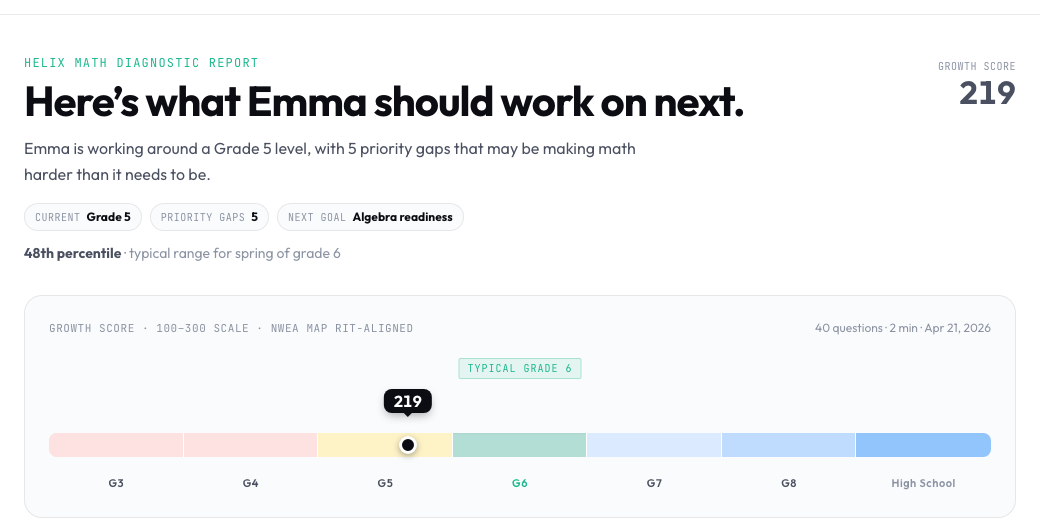
The first line names what your child should work on next. Under it sit a few short badges:
- Standing for their grade. One of Below typical, Just below typical, Typical, Just above typical, or Above typical, always compared with your child's own grade.
- Priority gaps. How many skills the diagnostic found that need review. This badge only appears when there is at least one.
- Next goal. The first target the practice plan works toward.
Beside them is the Growth Score, a number on Helix's own 100 to 300 scale, with a likely range under it. Read the range, not just the number. A single diagnostic is an estimate, and the range is how wide that estimate honestly is. If your child answered everything near the top of what the diagnostic measures, the score shows a plus sign (for example 240+) instead of a range, because there was nothing harder to place them against.
The Growth Score is not a MAP RIT® score and is not a prediction of one. The two have not been linked by any study, so do not compare the numbers point for point. For more on the score itself, see what the Helix Growth Score is.
If a session did not produce enough real answers (too few questions, or answers given too fast to mean anything), the report says so and shows no score at all. The skills your child did answer still appear below, and the diagnostic can be retaken.
The placement ladder
Under the badges, the score is marked on a ladder of grade bands: G3 through G8, then Above grade 8. Each band is the typical range for that grade on Helix's scale, and your child's own grade is labelled Typical Grade N. The ladder is a picture of the standing badge. It does not mean your child "is working at" a different grade.
The four math areas
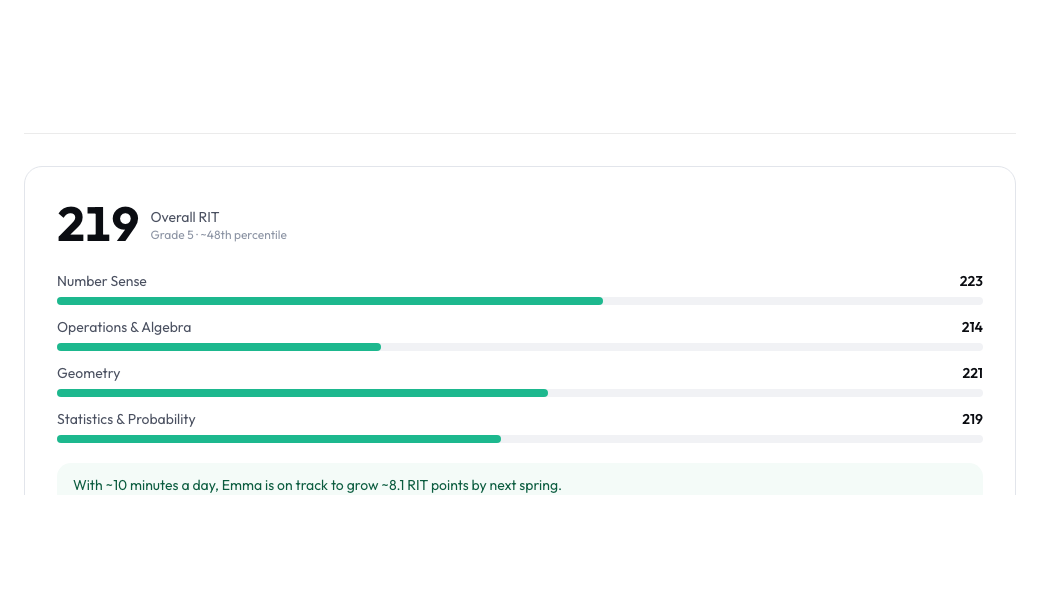
Four bars break the overall picture into the four big areas of grades 3 to 8 math:
- Number Sense. Place value, fractions, decimals, integers.
- Operations and Algebra. Expressions, equations, ratios and proportions, early functions.
- Geometry. Area, volume, angles, transformations, the coordinate plane.
- Statistics and Probability. Graphs, measures of center, chance.
The bars are views of one estimate, not four separate tests, so small differences between them are not meaningful. A clear difference is a hint about where to look. The Learning Map below is where you see it skill by skill.
The plan
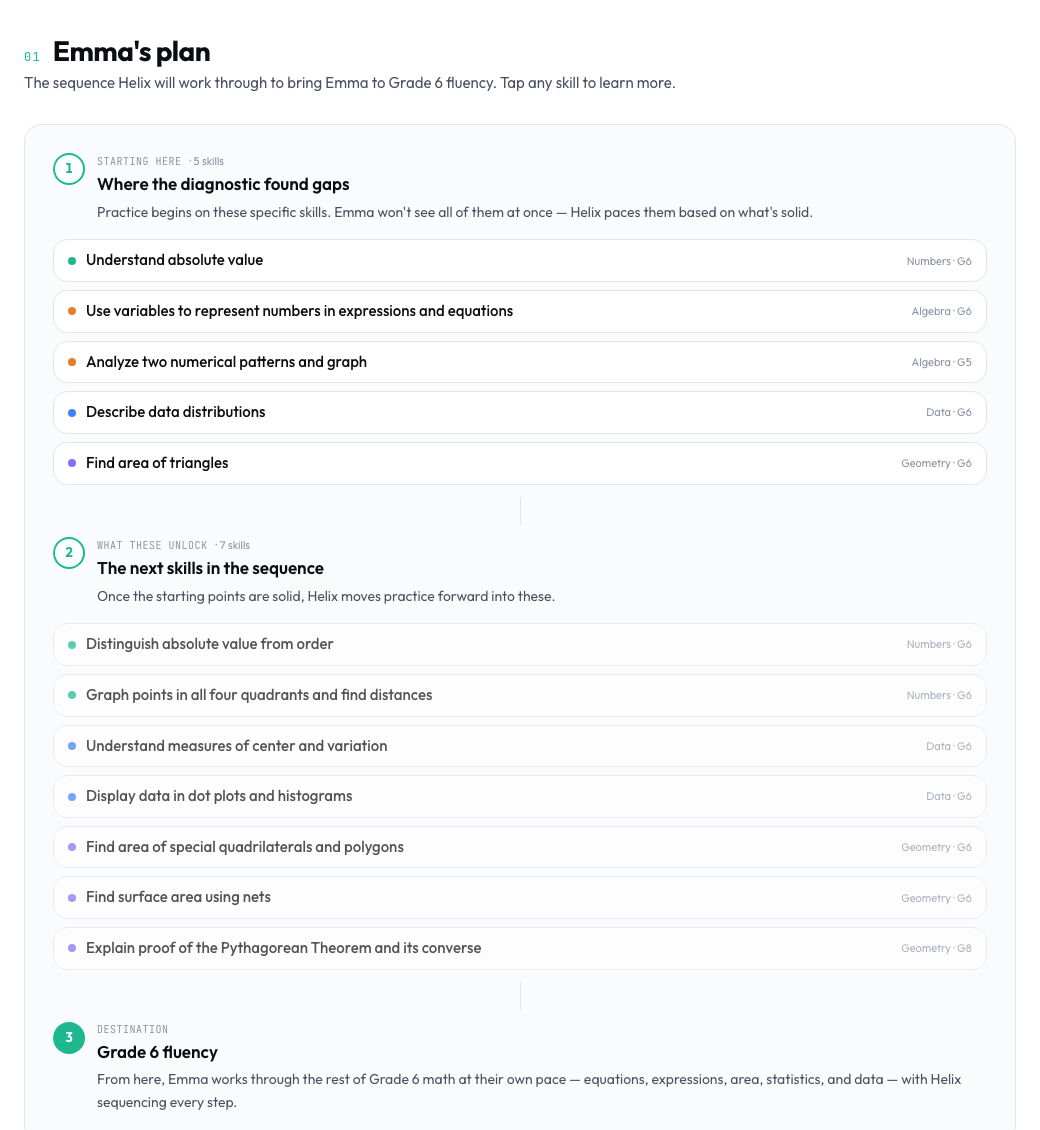
The first numbered section is your child's plan, in three phases:
- Starting points. Foundational skills that need review today. They often come from an earlier grade, and later skills depend on them, so practice starts here.
- Skills they unlock. The skills that build on those starting points.
- Grade-level fluency. The on-grade skills that complete the picture.
Tap any skill to see what it is and why it is in that position. You do not need to choose where to start; daily practice works through the plan in order and moves on when a skill holds up.
The Learning Map
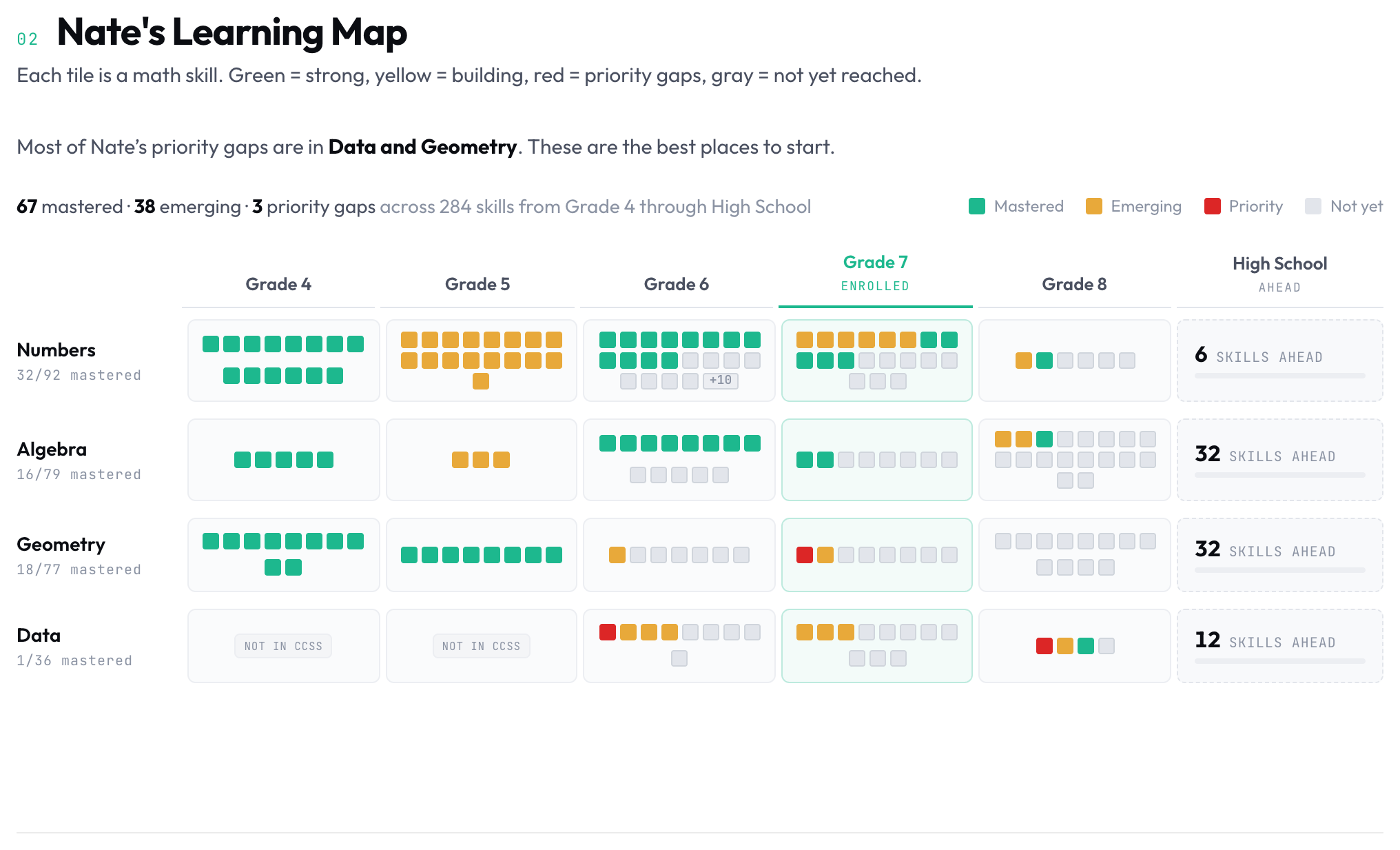
The second section is the Learning Map: a grid of skills, with the four math areas as rows and grades as columns. Each tile is one skill:
- Secure. Answered correctly and consistently.
- Developing. Some correct answers; the skill is forming.
- Needs review. Where targeted practice will help most.
- Not yet reached. The diagnostic did not test this skill, usually because it sits above where your child is working now.
The sentence above the map names the areas where most of the review skills are. It is counted from the tiles on the map, so it always agrees with them. If nothing needs review, it says so and points to what is still developing instead.
Two children with the same Growth Score can have very different maps. The map, not the number, is what the practice plan is built from.
How Helix works
The last section is a short description of daily practice: sessions of about 10 to 20 minutes, one skill at a time, difficulty that adjusts as your child works, and Ori, the built-in coach, who helps when your child is stuck without giving the answer away.
Sharing, printing, and emailing
The report can be shared with a link, printed on one page, or emailed, which is useful for a teacher, a tutor, or a co-parent.
What the report does not tell you
- It is not a MAP result. It does not predict a RIT score or a MAP percentile.
- It is one sitting. A tired afternoon or a rushed section shows up in the score. The likely range is there for that reason, and daily practice keeps adjusting as your child works.
- It does not forecast growth. Helix does not project future scores from a single diagnostic.
If the picture changes (a new MAP score, a change in homework, a new term), your child can start practice from the new score, or retake the diagnostic for a fresh report. Either way, the Helix Program builds the next practice from what it learns.
MAP® and RIT® are registered trademarks of NWEA. Helix Math is not affiliated with or endorsed by NWEA.